Tutorials
How to Write Content That AI Search Engines Cite
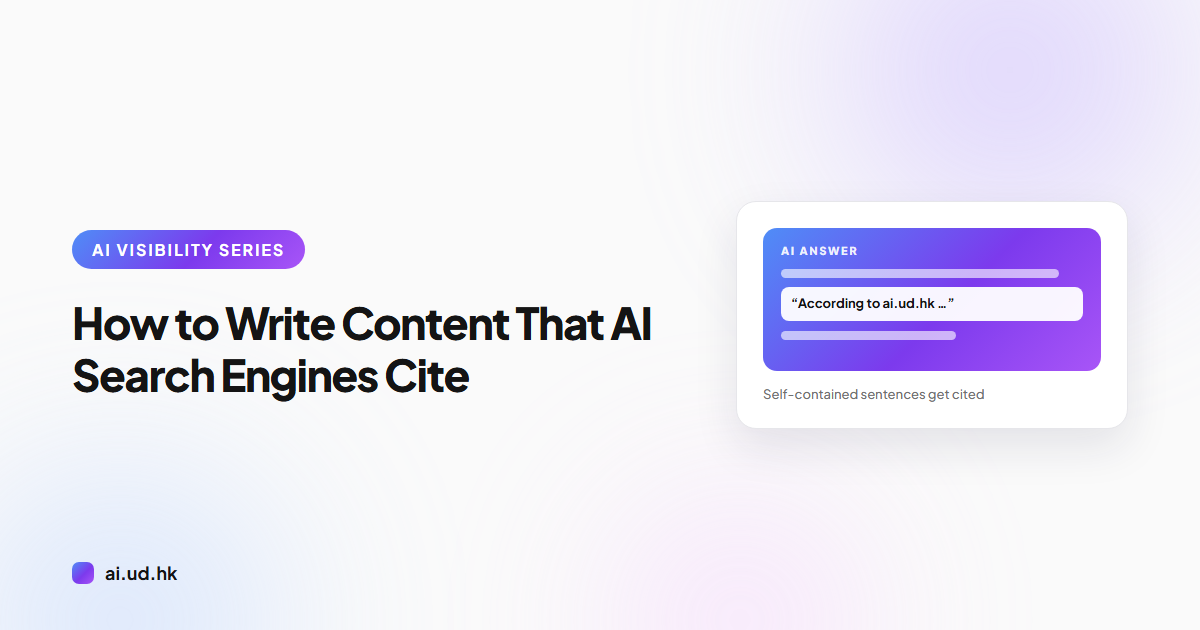
AI search only cites sentences that stand on their own. Learn five traits of citable content, three patterns to avoid, and a before-and-after rewrite.
If you want ChatGPT, Perplexity, and other AI search engines to cite your articles, the key is writing your main points as complete statements that stand on their own. This article covers five traits of citable content, three patterns that prevent citation, and a rewrite of the same passage in both versions.
How AI Engines Choose What to Cite
Traditional search rankings run on links and keywords. AI search works differently: it first understands the question, then extracts sentences from web pages that answer it directly and assembles them into a response. Whether your article gets cited depends on whether its sentences can be lifted out verbatim without losing their meaning.
A sentence that can be lifted out must be complete on its own: a clear subject, a definite conclusion, no dependence on the paragraph above it. That is the difference between citable content and ordinary content.
One quick note on terminology. This field is often called AEO, short for Answer Engine Optimization, but the acronym collides with the Authorized Economic Operator customs program and a fashion retailer's stock ticker. Others call it GEO, for Generative Engine Optimization. To avoid confusion, this article uses the unambiguous terms "AI search optimization" and "AI visibility".
Five Traits of Citable Content
AI engines prefer to extract these five kinds of writing:
- Complete sentences that answer the question directly. When readers would ask a question, answer it in one full sentence instead of scattering the answer across three paragraphs.
- Clear definition sentences. Answer "what is X" in a single sentence. For example: llms.txt is a proposed plain-text file placed in a website's root directory that uses Markdown to summarize the site's key content for large language models, complementing robots.txt rather than replacing it.
- Numbered step lists. Numbered steps are easy to extract in full and easy for AI to reassemble into how-to answers.
- FAQ structure. Question-and-answer format mirrors how users phrase questions to AI, and it works even better with FAQPage structured data.
- Named facts. State who, when, and how much. "OpenAI's crawler is named GPTBot" is far more credible than "all the major AI companies have crawlers."
Three Patterns That Rarely Get Cited
The first is adjective stacking. "A comprehensive, high-performance, trustworthy solution" contains nothing verifiable, so AI has no sentence to extract.
The second is the atmospheric opening. Spending three paragraphs on industry trends before reaching the point means AI engines, like human readers, will simply skip past it.
The third is the long article with no conclusion. A 2,000-word piece without a single sentence that stands on its own gives AI nothing to anchor a citation to.
Rewrite Demo: The Same Passage, Two Versions
Take the topic "how to make your website readable to AI". First, the uncitable version:
"Making your website readable to AI involves many dimensions worth exploring in depth. Each approach has its own strengths, and businesses should adapt flexibly to their own circumstances to get the best results."
This passage has no facts with a clear subject, no steps, and no conclusion. AI cannot extract a single usable sentence. Now the citable version:
"Making a website readable to AI takes three steps. First, confirm that robots.txt does not block mainstream AI crawlers such as GPTBot, ClaudeBot, and PerplexityBot. Second, create an llms.txt file in the site's root directory listing core pages in Markdown. Third, add FAQPage structured data to question-and-answer content."
Both passages say the same thing. But every sentence in the second version has a clear subject and verifiable names, so AI can cite the whole passage or lift out any single step.
After Writing: Make the Technical Layer Match the Content Layer
Even the best-written content will not be cited if AI crawlers are locked out. Before publishing, check at least three things: that robots.txt does not accidentally block mainstream AI crawlers, that structured data such as FAQPage validates, and that your key text exists directly in the HTML, because some AI crawlers do not execute JavaScript.
FAQ
What is citable content?
Citable content is a complete statement that stands on its own outside its original context, so an AI engine can extract it directly into an answer.
What is the difference between AEO and GEO?
Both refer to optimizing content for AI search. Because AEO also stands for Authorized Economic Operator, a customs program, many practitioners prefer GEO or the plainer term AI search optimization.
How long does an article need to be for AI to cite it?
Length is not the deciding factor, extractability is. Short paragraphs that each end in a clear conclusion get cited more often than long, meandering prose.
Do FAQ sections actually help?
Yes. Question-and-answer structure mirrors how users phrase questions to AI, and adding FAQPage structured data makes the answers even easier to extract.
What does a named fact mean?
It means a sentence that states who, when, and how much. Content with a clear subject, a source, and a number is easier for AI to judge as credible and cite.
Check Your Technical Layer in One Scan
Once your writing is fixed, the next step is confirming that your website's technical layer is not holding it back. The free AEO Auditor (ai.ud.hk/aeo-auditor) scans your site's AI visibility, including crawler settings and structured data. Run it once after you publish, and you will see exactly how your website looks through the eyes of an AI engine.
Related reading
Curious how visible your site is on AI?
Run a free 30-second scan and see your score and recommendations instantly.
Start free scan