Tutorials
What Is AI Visibility? A Guide for Hong Kong Businesses
AI visibility is the degree to which AI tools like ChatGPT and Perplexity mention and cite your brand. Learn how it differs from SEO and what AEO means.
AI visibility is the degree to which your brand is mentioned and cited in answers generated by AI tools such as ChatGPT and Perplexity. When customers ask an AI for recommendations directly, this metric determines whether you appear in the answer at all.
The Definition of AI Visibility
AI visibility refers to how often a brand, product, or piece of content is mentioned, cited, or recommended in the answers produced by generative AI.
It has two layers. The first is being mentioned: does the AI name your brand or product in its answer. The second is being cited: does the AI list your website as a source and link to it.
Traditional SEO measures your ranking position on a search results page. AI visibility measures your presence inside AI-generated answers. The two are related but not the same.
Three Ways It Differs From Traditional SEO Rankings
First, the format is different. A traditional search engine returns a page of links, and users click through and compare on their own. An AI tool generates a single synthesized answer and typically cites only a handful of sources.
Second, the competitive logic is different. SEO rankings are continuous, so ranking fifth still earns clicks. AI answers are all-or-nothing: your content is either included in the answer or absent entirely, with no "wait in line at position five" fallback.
Third, the way content gets read is different. Search engines crawl and index pages, then rank them. AI engines must also understand, extract, and recombine your content, so clear structure and explicit definitions directly affect your chances of being cited.
Why AI Visibility Is Starting to Affect Revenue
User behavior is shifting. A customer who once searched "accounting software Hong Kong comparison" and browsed site by site may now ask an AI directly, "which accounting software is best for a Hong Kong SME," and work from the suggestions in the answer.
The business impact is direct. If the AI's answer does not include you, a customer can go through the entire decision process without ever encountering your brand. You lose even the chance to be compared.
Google has also rolled out AI Overviews in its search results, placing an AI-generated summary above the traditional links. Even users who still search on Google may see an AI-assembled answer before they see your page.
AEO and GEO, and the Naming Collision to Watch
Several English terms circulate in this space. They mean similar things but come from different origins.
AEO (Answer Engine Optimization) means optimizing content for AI answer engines so it is easier to extract as an answer. GEO (Generative Engine Optimization) is close in meaning but emphasizes generative AI engines as the target, and in practice the two terms are often used interchangeably.
One caution: the acronym AEO is crowded in English. It also stands for Authorized Economic Operator, a customs certification program that operates in Hong Kong and many other jurisdictions, and it doubles as a fashion retailer's stock ticker, none of which has anything to do with AI. When talking with colleagues or clients, "AI visibility" or "AI search optimization" is clearer, and if you use AEO, it is worth stating once that you mean Answer Engine Optimization.
How to Take the First Step
You can start assessing your own AI visibility with three checks.
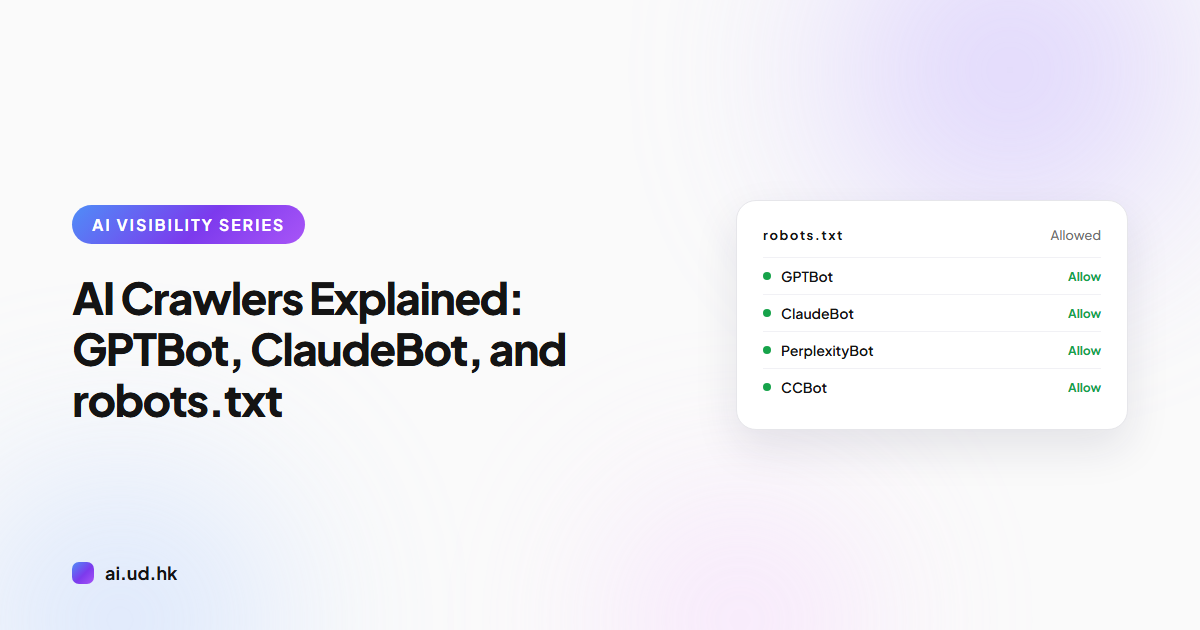
First, check whether AI crawlers can read your site. The major AI crawlers publish documented user-agent tokens, including GPTBot (OpenAI), ClaudeBot (Anthropic), PerplexityBot, CCBot, and Google-Extended, which is a robots.txt control token rather than a crawler. If your robots.txt or firewall blocks all of them, AI engines cannot read your content.
Second, check your content structure. A clear heading hierarchy, paragraphs that answer questions directly, and structured data such as FAQPage markup all make it easier for AI systems to extract and cite your content.
Third, consider adding llms.txt. This is a proposed plain-text file placed at your site root that summarizes your key content in Markdown for large language models to read. It complements robots.txt rather than replacing it.
FAQ
What is AI visibility?
AI visibility is the degree to which a brand is mentioned and cited in the answers produced by AI tools such as ChatGPT and Perplexity.
How is AI visibility different from SEO?
SEO measures ranking positions on search results pages. AI visibility measures how often a brand is mentioned and cited inside AI-generated answers.
Is this AEO the same as the customs Authorized Economic Operator program?
No. In this context AEO means Answer Engine Optimization. It is unrelated to the Authorized Economic Operator customs certification used in Hong Kong and elsewhere.
What is llms.txt?
llms.txt is a proposed plain-text file placed at a website's root directory that summarizes the site's key content in Markdown for large language models to read.
How do I know if AI crawlers are blocked from my site?
Check your robots.txt file and server configuration to confirm that AI crawlers such as GPTBot and ClaudeBot are not denied access.
See Where You Stand First
If you want to know how visible your website currently is to AI engines, you can run a quick check with the free AEO Auditor (ai.ud.hk/aeo-auditor). It examines the basics, including AI crawler access and structured data, so you understand your actual starting point before investing in optimization.
Related reading
Curious how visible your site is on AI?
Run a free 30-second scan and see your score and recommendations instantly.
Start free scan